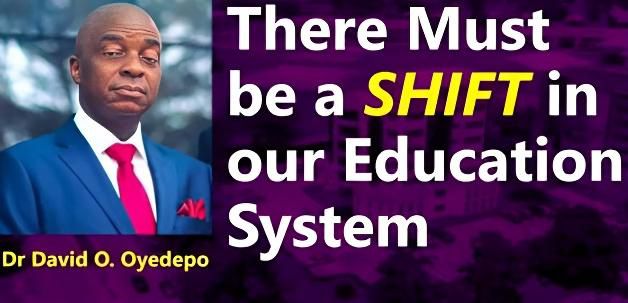
Covenant University hosted a special public lecture on September 24, 2024, in honour of its Chancellor and Chairman of the Board of Regents, Dr. David O. Oyedepo, to celebrate his 70th birthday.
The event highlighted Dr. Oyedepo’s lifelong contributions to education, leadership, and faith, while urging a fundamental transformation in Nigeria’s education system to better address contemporary challenges.
Speaking at the lecture, Dr. Oyedepo emphasized the urgent need for a shift from a certificate-driven educational model to one focused on real-world contributions.
“Our education system must evolve to address the unique challenges we face in this part of the world,” he stated.
“We must move beyond the obsession with acquiring degrees and begin fostering an education that encourages tangible contributions to society.”
Dr. Oyedepo elaborated on the need to adapt educational curricula to be more relevant to industries, commerce, and the public sector.
He called for an overhaul of traditional academic structures to reflect faster learning methodologies, warning that time was running out for the current generation.
“We are at risk of intellectual extinction like the dinosaurs of history if we do not act now,” he warned.
He advocated for the reconstruction of intellectual frameworks in Nigerian universities, urging them to serve as solution centers for pressing national and global issues.
“It’s time to reconstruct our intellectual armoury and equip ourselves with knowledge that can turn our educational institutions into solution hubs, sought after by governments and industries alike,” Oyedepo said.
He lamented that Africa’s political leadership has failed to provide sustainable solutions to its problems, urging universities to step into that role.
Quoting a famous remark, he said: “The empires of the future will not be built by stone walls, bricks, or armoured tanks—they will be empires of the mind. Until something changes within us, nothing will change around us.”
He called for an educational transformation, one that fosters innovative thinking, creativity, and problem-solving to drive societal progress.
“Our universities must become like engineering workshops where we reprogram the intellectual systems of our youth, preparing them for lives of productivity and value creation,” Dr. Oyedepo added.
He called for an end to the passive approach to education, advocating for a proactive stance where students are taught to see beyond their immediate needs and ask how they can contribute to the betterment of society.
He posed several key questions to educators and students alike: “What do I have to offer to make life in my environment better? How can I help to alleviate the rising scourge of youth unemployment?”
Dr. Oyedepo stressed that the solution to Nigeria’s problems lies within its education system, urging universities to become centres where governments, industries, and private sectors seek answers.
He challenged the notion that formal education and academic qualifications have any value if they do not provide practical solutions to the challenges at hand.
“Knowledge is the solution platform for all the issues we face, whether as individuals or as nations. The time has come for us to review the content of our education system to better address the urgent needs of our time,” he said.
Drawing from Nigeria’s rich history, he emphasized the problem-solving abilities of Nigeria’s forefathers, who, despite little formal education, demonstrated an understanding of the land, developed agricultural methods, and defended their territories.
Dr. Oyedepo argued that today’s educational institutions must harness this indigenous problem-solving spirit to confront contemporary challenges.
“We have a history of solving problems. We must draw from that history and provide indigenous solutions without apology,” he asserted.
He emphasized that capacity utilization, not just capacity, is the key to a brighter future.
“What makes a great leader is not just their capacity, but how they utilize it. No one can take a test or exam on behalf of another. What secures your change of story can not be delegated,” Dr. Oyedepo remarked, pointing out the pitfalls of the dependency culture prevalent in many African societies.
Covenant University, he said, had long adopted an “unapologetic departure” from traditional education methods, which secured its place as a leading global institution.
He noted that the institution’s success lay in its focus on offering solutions to the real-world challenges facing students and society at large. “The world doesn’t recognize you by what you have, but by what you add,” he added.
He noted that Nigeria’s problem is not a lack of education but a failure to provide the right kind of education.
Dr. Oyedepo called for a complete repackaging of Nigeria’s educational system, where universities become problem-solving centres.
He lamented that too often, universities are seen as mere pathways to earning degrees rather than places where innovative solutions to pressing issues are developed.
“Universities should be centres of knowledge and solutions, not just places where empty rhetoric and philosophies that will never see the light of day are propagated. We have the potential. We should utilize it without relying on imported concepts that won’t work for us,” he stated.
As an example of the impact of indigenous solutions, Dr. Oyedepo highlighted Covenant University’s own Canaanland campus, which has not experienced a power failure or water shortage in 25 years.
“You can not be committed without being creative, and you can not be creative without being productive. You can not be productive without being successful, and you can not grow your success without making an impact,” he explained.
In his closing remarks, Dr. Oyedepo stressed that Nigeria has what it takes to become a great nation, and the responsibility for its future lies not only with the political sector but also with educational institutions.
He urged educators and students to keep developing indigenous content and principles that will demand the world’s attention. “Keep developing content that the nation will be forced to listen to because the world is watching,” he concluded.

 INN-HOUSE☆