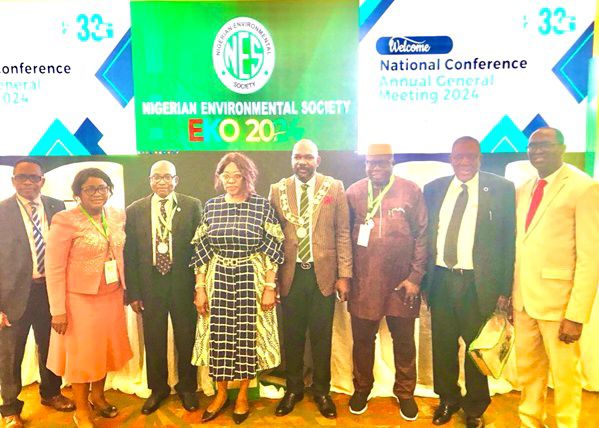
The Nigerian Environmental Society (NES) held its 33rd Annual National Conference and General Meeting (AGM) in Lagos, the “Center of Excellence,” from October 30 to November 1, 2024, at Eko Hotel in Lagos, Nigeria.
Tagged “EKO 2024,” the conference focused on addressing critical global and local environmental issues, with the goal of proposing sustainable solutions to support Nigeria’s development and economic growth.
During a press briefing in Abuja, NES National President Dr. Efegbidiki Okobia earlier highlighted the significance of this year’s theme, “Environmental Resource Management, Conservation, and Protection in the Global Emerging Innovative Technology for Sustainable Development.”
He noted that the conference aimed to explore scientific and practical approaches to global environmental challenges, centring discussions around sustainability strategies with both national and international impact.
Dr. Okobia explained that alongside the main theme, various sub-themes would be covered in technical sessions, delving into complex environmental issues affecting the global South.
He remarked that the society remained committed to advocating for environmental protection and promoting professionalism within the environmental sector.
The high-profile event featured keynote speaker Prof. Olanrewaju Adigun Fagbohun, former Vice Chancellor of Lagos State University.
Welcoming dignitaries to the conference, the Chairman of the NES 33rd Annual Conference Local Organizing Committee, Dr. Eugene Itua, emphasized the significance of this year’s event, where experts, distinguished speakers, and stakeholders will share insights on topics under the theme “Environmental Protection, Preservation, Conservation, Remediation, and Promotion of Environmental Sustainability.”
According to him, the theme highlights the society’s ongoing commitment to addressing critical ecological issues through collaborative and innovative approaches.
Dr. Itua underscored the Nigeria Environmental Society’s leadership in environmental advocacy and its dedication to creating a forum for collaboration and knowledge-sharing among participants.
“The goal of the conference is to generate practical strategies that support a greener and more sustainable future for Nigeria,” he said.
Lagos State Governor Babajide Sanwo-Olu served as the Chief Host, with the conference drawing a wide array of prominent attendees, including Secretary to the Government of the Federation Senator George Akume, Honourable Minister of Environment Balarabe Lawal Abbas, the Eleko of Eko Rilwan Akiolu, Ogun State Governor Prince Dapo Abiodun, and Borno State Governor Babagana Zulum.
Governor Sanwo-Olu, represented by his Special Adviser on Sustainable Development Goals (SDGs), Dr. Oreoluwa Finnih-Awokoya emphasized the importance of environmental resource management amid challenges from population growth, industrial expansion, and natural resource depletion.
He praised NES for its dedication to environmental stewardship, stating, “Responsible management of resources is essential for sustainable growth. Our administration has prioritized environmental sustainability to ensure future generations benefit from our resources.”
The governor elaborated on Lagos State’s sustainability efforts, highlighting advances in waste management through the Lagos Waste Management Authority (LAWMA), the Blue Box Recycling Initiative, and waste-to-energy programs aimed at reducing reliance on landfills.
He also underscored Lagos’ climate action plan, targeting net-zero emissions by 2050, which includes initiatives in clean public transportation and renewable energy.
Addressing reforestation, air quality improvement, and urban heat reduction, the governor noted investments in flood prevention and citizen-engagement programs like “One House, One Tree,” which encourages community tree planting to enhance public well-being.
In his keynote address, Prof. Adigun Fagbohun advocated for greater investment in technology-focused tertiary education, calling on national banks to provide affordable credit for technological advancement in environmental sustainability.
He urged the government to implement supportive policies, including subsidies, green bonds, and policy consistency, to create a stable investment environment for sustainable development.
Dr. Okobia, in his remarks, further expressed optimism that the conference would heighten environmental consciousness and reinforce NES’s leadership role in Nigeria’s environmental efforts.
He urged stakeholders to support NES’s mission to advance sustainable practices across the country.
The conference attracted environmental experts, scholars, and policymakers, including Dr. Eugene Ituah, Engr. Amid Adekunle Oduborisa (a pioneer member of the society), Prof. Babajide Alo, Dr. Dorothy Bassey, Prof. Ignatius Madu, HRM Oba Adeoriyomi Akeem Oyebo, the Obateru of Egbin Kingdom, and representatives from Nigeria’s 36 states, underscoring NES’s commitment to fostering a collaborative approach to environmental sustainability.

 INN-HOUSE☆