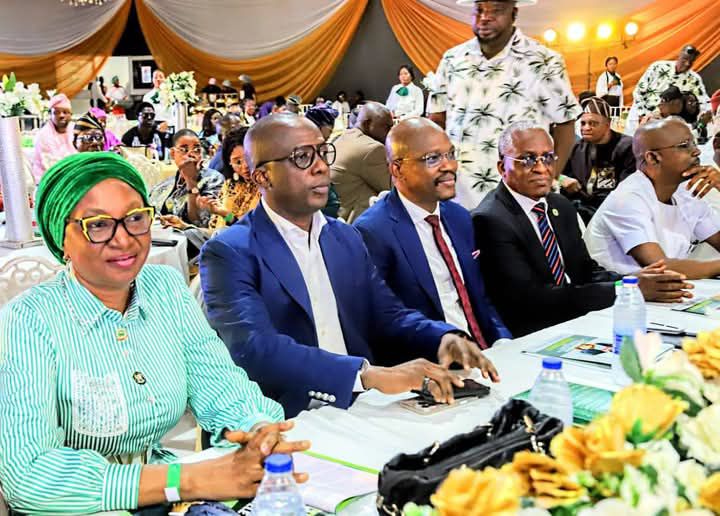
The Lagos State Commissioner for the Environment and Water Resources, Tokunbo Wahab on Thursday urged the members of the Nigerian Institute of Town Planners across the state to comply with environmental laws in every stage of urban development.
Mr. Tokunbo Wahab gave the advice at the investiture and inauguration of the 19th Chairman of the Executive Committee of the State Chapter of the Nigerian Institute of Town Planners, held at Ikeja.
Wahab said that to effectively address the challenges of urbanisation and environmental degradation, town planners must also leverage technology, digital tools and Geographic Information Systems (GIS), to improve decision-making processes and optimise resource allocation.
He added that collaboration is another critical aspect, translating to partnerships between government agencies, private sector stakeholders, and local communities to ensure alignment of objectives and inclusivity.
He described the theme of the event, “The Intersection of Environmental Laws and Physical Planning: Addressing Urban and Ecological Challenges,” as a critical area of focus for the state.
He explained that the State Environmental laws provide the framework for ensuring that urban development aligns with sustainable objectives, while physical planning translates these objectives into actionable outcomes.
The Commissioner averred that the environmental laws and physical planning will together define and address the growing challenges of urbanisation, ecological degradation, and resource management in the state.
He stressed that in a state like Lagos where rapid population growth exerts significant pressure on infrastructure, housing, and natural resources, the integration of environmental laws into planning processes is not optional but highly essential.
According to him, the Urban and Ecological Challenges which Lagos faces are unique challenges arising from its position as Nigeria’s commercial hub and a coastal megacity. Issues such as flooding, waste management, deforestation, and informal settlements are compounded by climate change and socio-economic factors.
“The aforementioned challenges demand a coordinated response that combines sound urban planning with strict environmental governance”, he said.
Wahab said Physical planning should guide the efficient use of land while protecting critical ecosystems, noting that this requires strategies that balance urban growth with environmental conservation to ensure long-term sustainability and resilience.
He declared that Town Planners are central to the process of environmental development as their expertise in spatial planning, land use management
and urban design must align with the principles of environmental sustainability.
“The Lagos State government is committed to supporting these efforts and initiatives such as the waste-to-energy projects and afforestation programmes that illustrate how we integrate environmental considerations into urban planning. We count on the Town Planners to support these initiatives by adhering to standards promoting innovation and fostering compliance with relevant laws,” he added.
The Commissioner said the challenges the State faces are immense, but together, everyone has the power to transform the cities into places of opportunity, resilience and sustainability.
He said the government recognises that capacity building remains vital; equipping professionals with the necessary skills and knowledge will enable them to meet the evolving demands of urban and environmental management effectively.
The newly inaugurated Chairman of the Association, Tpl. Oladele Akindele pledged that the newly inaugurated members, as well as the entire association, will collaborate with the State Government to achieve a resilient and functional City.
He said the Committee will ensure that all Town Planning practitioners in the State align with the code of ethics of the association, adding that a livable physical environment will be achieved in this regard.

 INN-HOUSE☆