The Lagos State Government has stepped up its environmental enforcement measures through the reinvigorated Kick Against Indiscipline (KAI) unit under the Ministry of Environment and Water Resources, in a renewed drive to enforce environmental laws and ensure a cleaner, safer Lagos.
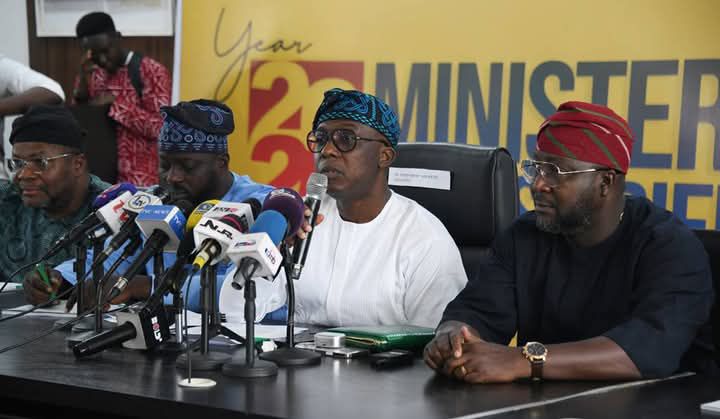
Mr. Tokunbo Wahab, the Honourable Commissioner for the Environment and Water Resources, made this known during the Year 2025 Ministerial Press Briefing held at the Bagauda Kaltho Press Centre, Alausa, to commemorate the sixth anniversary of Governor Babajide Sanwo-Olu’s administration.
Reeling out the achievements of the ministry, Wahab disclosed that 6,939 persons were arrested for various environmental infractions. Specifically, 6,789 individuals were apprehended for failure to use pedestrian bridges, while 150 persons were arrested for open defecation on pedestrian bridges, which obstructed cleaning operations.
In addition to the arrests, 192 Environmental Abatement Notices were served across the state to offenders of sanitation laws. The Commissioner also noted that 3,786 street traders, environmental polluters, and cart pushers were apprehended and prosecuted, reflecting the administration’s zero tolerance for environmental degradation.
The KAI team, working in conjunction with the Lagos State Task Force on Environmental and Special Offences, carried out critical enforcement operations including clearing of illegal structures and shanties across key locations such as Apongbon Bridge, Lekki, Victoria Island, Agege, Obalende, and along the Lagos-Badagry Expressway.
Addressing efforts to combat flooding, Wahab highlighted the state’s partnership with waste conversion organisations, which he said has significantly reduced flash floods by preventing waste and silt buildup in drains. He noted that more than 300km of secondary collector drains and 70km of primary drainage channels have been awarded and are at varying stages of construction, aimed at improving stormwater flow and reducing maintenance frequency.
Between 2023 and 2025, the state recorded the cleaning and maintenance of 666,740.50 kilometers of secondary collector drains across 397 locations. Additionally, enforcement efforts led to the removal of structures obstructing drainage alignments, resulting in the restoration of 12 primary channels and 84 secondary collectors measuring 32.5km and 96km respectively.
The Emergency Flood Abatement Gang (EFAG) cleaned 181 collectors totaling 242,846.50 meters in 2024, with 72 collectors cleaned so far in 2025 covering 166,846.50 meters.
To support schools prone to flooding, the government commenced de-flooding of 18 drainage channels around public schools in 2024 across Agege, Alimosho, Surulere, Epe, Ikorodu, Badagry, and Ajeromi-Ifelodun. Seven additional channels have been de-flooded in 2025.
Wahab also revealed that a comprehensive de-flooding project is ongoing across Lagos Island, covering Oroyinyin, Idumagbo, Binuyo, Aroloya, Epe, and Ojo-Giwa. The project aims to permanently solve the area’s flooding challenges.
A major highlight was the completion of a state-of-the-art pumping station in Ilubirin, described as the first of its kind in Africa. This innovation will effectively discharge stormwater from Lagos Island into the Lagoon via an elevated channel system.
In support of real-time data collection for climate and flood management, Wahab noted the year-round maintenance of River Gauging Stations in Ikorodu, Ikoyi, and Kara, as well as Automatic Weather Stations in Ikeja, Ikorodu, and Victoria Island.
On climate resilience, the Commissioner emphasized urban greening initiatives, including expanded air quality monitoring, creation of parks, and tree planting efforts. The Lagos State Parks and Garden Agency (LASPARK) has launched a “Trees for Lagos” campaign to plant 50,000 additional trees in two years.
In terms of access to potable water, Wahab announced the revival of the 70 million gallons per day (MGD) Adiyan II water project, set to benefit over five million residents upon its 2027 completion. He also confirmed the recommissioning of the 2MGD Mosan-Okunola facility, restoring clean water to Baruwa-Abesan after 25 years, alongside the successful rehabilitation of the Isashi waterworks in 2024.
In conclusion, Wahab affirmed that the State Government remains committed to building a cleaner, flood-resilient, and environmentally sustainable Lagos through decisive policies, infrastructural investments, and continuous public engagement.

 INN-HOUSE☆