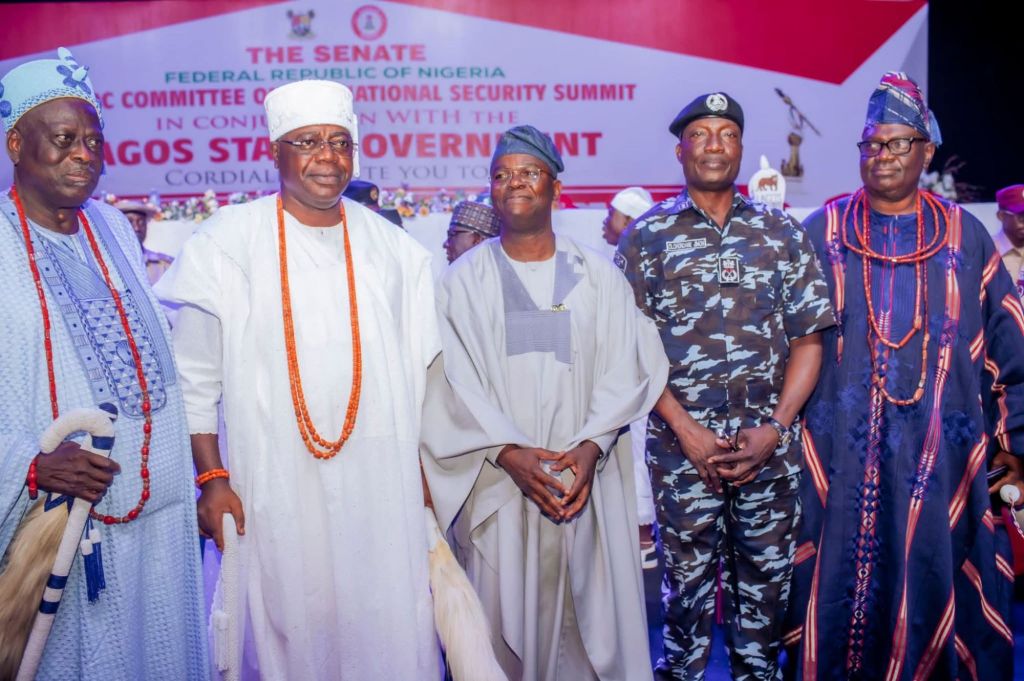
Lagos, Nigeria — Senator Mukhail Adetokunbo Abiru, the Senator representing the Lagos East Senatorial District, recently chaired the South-West Zonal Interactive Hearing of the 10th Senate Ad-hoc Committee on the National Security Summit, as key stakeholders gathered in Lagos to map out practical strategies for addressing Nigeria’s persistent security challenges.
The engagement, which is part of the Senate’s nationwide consultations, brought together distinguished senators, traditional rulers, security professionals, and community leaders.
The goal: to harvest real, community-driven insights that will shape a comprehensive national security framework.
Senator Mukhail Adetokunbo Abiru is the Chairman of the South-West Geopolitical Zone Interactive Hearings under the 10th Senate’s Ad-Hoc Committee on the National Security Summit.
In addition, he chairs the Senate Committee on Banking, Insurance and Other Financial Institutions, and heads the Southern Senators’ Forum.
In his remarks, Senator Abiru noted that although the South-West remains one of the most economically progressive and culturally diverse regions of the country, rising incidents of kidnapping, banditry, farmers–herders clashes, and other violent threats demand swift and decisive action.
“We must act with urgency to protect the peace our people have long enjoyed,” Abiru stated, warning that the region must not be allowed to become a haven for criminality.
The hearing examined a broad range of issues, including community intelligence systems, governance gaps, youth value reorientation, the role of traditional institutions, and enhancing cooperation between citizens and security agencies.
Senator Abiru emphasized that while international support can be helpful, Nigeria’s long-term security must be anchored on homegrown strategies rooted in local understanding, culture, and the resilience of its communities.
He further urged the media to adopt narratives that promote unity rather than deepen divisions, stressing the role of responsible messaging in national stability.
Reiterating the Senate’s commitment, Abiru assured that contributions from the zonal hearings will feed into a strong and actionable legislative framework designed to strengthen security and economic growth nationwide.
“Nigeria belongs to all of us. Securing it is our shared responsibility; and together, we will build a safer and more prosperous future,” he said.
The Governor of Lagos State, Mr. Babajide Olusola Sanwo-Olu, represented by the Chief Executive Officer of the Lagos State Security Trust Fund, Dr. Ayodele Ogunsan, reaffirmed his administration’s commitment to strengthening the state’s security architecture.
He also stressed the need for a regional security framework, noting that security is crucial not only for peace but also for economic stability.
Sanwo-Olu stated that governors in the region must recommit to a unified regional approach, which includes transforming Amotekun into a more cohesive, well-equipped, and technology-driven command capable of supporting cross-state intelligence sharing and joint operations.
He added that traditional institutions — Obas and community leaders — should remain central to this effort, as they best understand the pulse of local communities.
According to him, security goes beyond maintaining peace and directly affects economic survival. He warned that insecurity disrupts markets, farmlands, transportation, and investment, ultimately shrinking GDP, destroying livelihoods, and stalling growth.
“A region that cannot guarantee safety cannot guarantee prosperity,” he said, emphasising the need for a proactive, intelligence-led, and community-rooted strategy.
In his remarks, Senator Ibrahim Jimoh, representing Ondo South and sponsor of the bill establishing the National Security Summit, said terrorism and insurgency require non-conventional strategies that combine both military and civilian interventions.
Senator Gbenga Daniel, representing Ogun East, also called for stronger collaboration among stakeholders to tackle insecurity across Nigeria.
Presenting his paper, the Lagos State Commissioner of Police, Moshood Jimoh, highlighted the importance of sustaining the current security momentum. He stressed that most security challenges are local in nature, and therefore demand solutions developed at the local level.
Speaking on behalf of traditional rulers, the Alara of Ilara in Epe, Lagos, Oba Olufolarin Ogunsanwo, called for enhanced community policing, the deployment of modern technology, and the establishment of a joint task force involving all security agencies.
He further advocated expanded police recruitment, increased funding, better equipment, and more employment opportunities to reduce youth restiveness and associated risks.
Oba Ogunsanwo acknowledged that President Bola Tinubu’s administration has intensified collaboration with international partners but noted that weak grassroots structures continue to hinder meaningful progress.
Also contributing, the Aare Onakankanfo of Yorubaland, Iba Gani Adams, reiterated that the creation of state police remains a critical solution to Nigeria’s widespread insecurity.
Representatives of civil society organisations, women, youth groups, as well as Christian and Islamic leaders, equally called for improved welfare packages for security operatives to ensure they are motivated to carry out their duties diligently, without fear or favour.
The South-West session is one of several zonal hearings scheduled as part of the 10th Senate’s broader national security reform initiative.

 INN-HOUSE☆