By redefining how creativity is taught and who it is taught to, Oshodi Art Gallery is quietly shaping a more inclusive cultural future for children with special needs.
Art, at Oshodi Art Gallery, is not restricted to technique or talent. It is a tool for recognition, patience, and belonging—especially for children whose abilities are often overlooked in conventional learning spaces.
On a typical day at the gallery, sixteen-year-old Solomon Adebiyi dashes toward the entrance gate with unmistakable excitement. Without being prompted, he swings it open, his face lit with pride.
His confidence is unfiltered. Solomon is a child with special needs, but within the walls of Oshodi Art Gallery, he is not treated as an exception. He is part of the rhythm of the place.
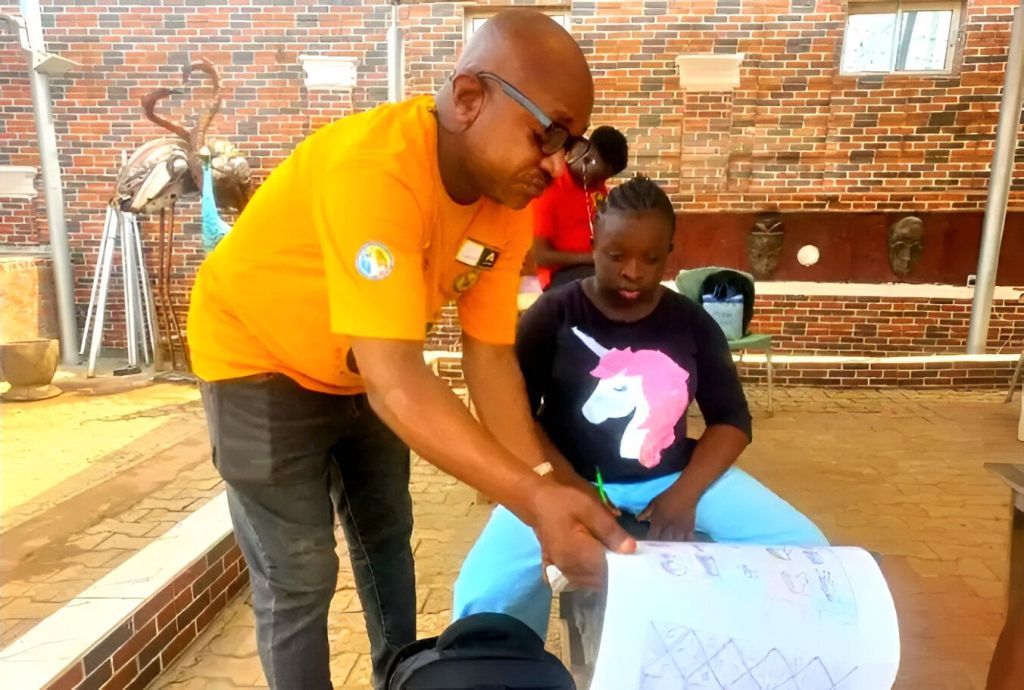
Just a few steps away, in a learning section designed specifically for young mentees, thirteen-year-old Blessing remains deeply focused on her work.
She pauses briefly to wave before returning to the task before her—dots forming lines, lines shaping meaning, colours gradually finding their voice. Like Solomon, Blessing is a child with special needs. And like him, she has purpose here.
This is not a gallery governed by hushed tones or rigid rules. It is animated by movement, repetition, and careful attention.
At Oshodi Art Gallery, art is not limited to finished works displayed on walls or sculptures awaiting collectors. It also exists in the quiet progress of children learning to express themselves in ways the world has not always allowed.
Embedded within the gallery is a special art school dedicated to children with special needs. It does not announce itself with spectacle or sentimentality. There are no banners of pity or charity. Yet its impact is unmistakable.
Parents regularly arrive with children who struggled in traditional classrooms—not due to lack of intelligence, but because the system failed to adapt to their pace and needs. At Oshodi Art Gallery, learning is redesigned.
Instruction meets the child where they are, not where they are expected to be.
“Art has to begin from the dot,” explains Dr. Seyi Paul Oshodi, artist, creative consultant, collector, and founder of Oshodi Art Gallery.
Before alphabets or numbers, the children are introduced to dots—different kinds of dots—then gently guided into lines: straight, curved, broken, vertical, horizontal.
From lines, shapes begin to appear. Circles, squares, triangles emerge not as abstract theory but as discovery. Shapes are arranged, repeated, stacked, and explored until patterns begin to make sense.
“They are special children,” Dr. Oshodi says. “Many of them cannot read, and many cannot process information the conventional way. So we return to the basics. We give them one-on-one attention. That is what they need most.”
Attention is central to the learning process here. Art is not presented as clinical therapy, but as a visual language—one that helps the children organise thought, recognise form, and communicate beauty without the pressure of verbal explanation.
When colours are introduced, something remarkable happens. The children respond instinctively. They recognise beauty immediately. From colour recognition, they move into simple drawing methods—structured, gentle, and systematic. Progress is never rushed or forced.
“They are catching up,” Dr. Oshodi notes. “What they need is time and focus.”
The curriculum also includes traditional methods of colour creation, where children learn to extract pigments from plants, leaves, and flowers. Through this process, colour becomes something alive and intentional, linking art to history, environment, and indigenous knowledge.
Beyond the classroom, the children are guided through the gallery itself. They encounter sculptures, paintings, textures, and forms. They learn to identify objects and name them, understanding that what they are learning exists within a larger cultural world.
This exposure is deliberate. It reinforces a powerful idea: these children are not separated from culture—they are part of it. They are not observers at the margins of creativity. They open gates. They greet visitors. They work on their briefs. They belong.
While Oshodi Art Gallery is home to thousands of African artworks, its most profound expressions may never be framed or sold. They appear in quieter moments—when a child concentrates longer than before, when anxiety softens, when confidence begins to stand taller.
Dr. Oshodi believes strongly in the societal relevance of these children.
“When they are properly guided, they produce excellent results,” he says. “Many outgrow the condition with time. They can work. They can marry. They can live full lives. But only if they are not neglected.”
In a world that often equates luxury with excess, Oshodi Art Gallery offers a different definition: time, patience, and intentional care. It reminds us that culture is not preserved only in bronze, canvas, or wood—but in how a society treats its most vulnerable.
As the visit draws to a close, Solomon stands a little taller. Blessing looks up again, her expression calm and assured. Here, art does not demand that children with special needs fit into rigid structures.
Instead, creativity bends, adapts, and grows with them—quietly redefining inclusion, community, and cultural responsibility in contemporary Africa.

 INN-HOUSE☆