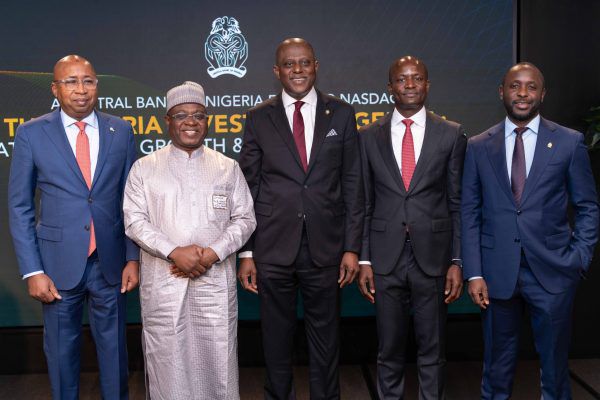
New York, April 17, 2025 — Nigeria’s reform drive and investment prospects were in focus as the Central Bank of Nigeria (CBN), in collaboration with NGX Group, J.P. Morgan, and the African Private Capital Association (AVCA), hosted a Private Investor Forum at the NASDAQ Market Site in New York.
Themed “The Nigeria Investment Agenda: Pathways for Growth & Global Partnerships,” the event brought together leading representatives from global financial institutions including Citi, JPMorgan Chase, Standard Chartered, and Jadara Capital Partners.
In his address, the Governor of the Central Bank of Nigeria outlined the country’s commitment to deepening economic reforms, stressing the progress made in foreign exchange liberalisation, subsidy removal, and the drive towards macroeconomic stability.
He reaffirmed the government’s goal of positioning Nigeria as a prime destination for global investment and building strong international partnerships for sustainable growth.
Participants at the forum generally acknowledged that Nigeria’s recent macroeconomic reforms are commendable and represent steps in the right direction. They noted that the policy changes had contributed to a notable shift in investor sentiment towards Nigeria.
However, investors also pointed out lingering concerns over oil price volatility, capital repatriation risks, and high transaction costs, cautioning that maintaining sustained investor confidence would require Nigeria to carefully manage structural and external risks, particularly those tied to the global oil market.
Joyce Chang, Chair of Global Research at JPMorgan Chase, commended Nigeria for its progress in addressing long-standing structural issues, including the removal of fuel subsidies and the liberalisation of the foreign exchange market.
She emphasized that Nigeria is becoming more mainstream in emerging market investment discussions. However, she also warned that external pressures such as U.S. tariff hikes and the increased risk of a global recession could adversely affect crude oil prices and expose Nigeria to macroeconomic fragility.
She stressed that while Nigeria had been a top emerging market recommendation for JPMorgan over the past 18 months, oil price volatility remained a significant risk.
Razia Khan, Chief Economist for Africa and the Middle East at Standard Chartered, highlighted the positive impact of Nigeria’s foreign exchange reforms and monetary tightening measures, which have created a foundation for reduced dependence on oil revenues.
She stressed that Nigeria is at the beginning of a credible path toward economic diversification and that its growing population and the upcoming national census are strong indicators of the country’s future consumer market potential.
Khan urged policymakers to remain steadfast in their reform agenda, noting that foreign investors had not yet fully positioned themselves for the scale of Nigeria’s future growth.
Jason Rekate, Global Co-Head of Corporate Banking at Citi, observed that investor interest in Nigeria had risen sharply compared to previous years. He attributed this renewed interest primarily to the transparency introduced by recent forex reforms, which now allow easier capital inflows and outflows.
Rekate remarked that discussions around Nigeria had shifted significantly, with clients now inquiring about how soon they could invest rather than whether they should.
Nevertheless, he cautioned that the fragility of global sentiment, particularly fears of a global recession, could still impact Nigeria’s new financial structures and exert pressure on the naira.
Ahmad Zuaiter, Co-Founder and Chief Investment Officer of Jadara Capital Partners, welcomed the momentum of reforms in Nigeria but pointed out that significant frictions still exist within the capital markets.
He noted that transaction costs remain comparatively high, especially when measured against peer markets like Saudi Arabia and Egypt, largely due to regulatory inefficiencies and levies such as stamp duties.
Zuaiter stressed the importance of providing credible signals to investors that past practices of capital controls and circuit breakers would not return, as these had historically discouraged portfolio investment.
Throughout the forum, investors offered several recommendations aimed at boosting Nigeria’s attractiveness to foreign capital.
They advocated for sustained consistency in foreign exchange policy without arbitrary market interventions, a reduction in transaction costs and regulatory barriers, clearer policy direction on non-oil revenue reforms such as taxation, improved ease of doing business with a focus on infrastructure and travel, and a stronger commitment to transparency in monetary and fiscal policy communication.
The Private Investor Forum concluded on a note of cautious optimism, with participants recognizing Nigeria’s efforts to reposition itself within the global investment landscape.

 INN-HOUSE☆