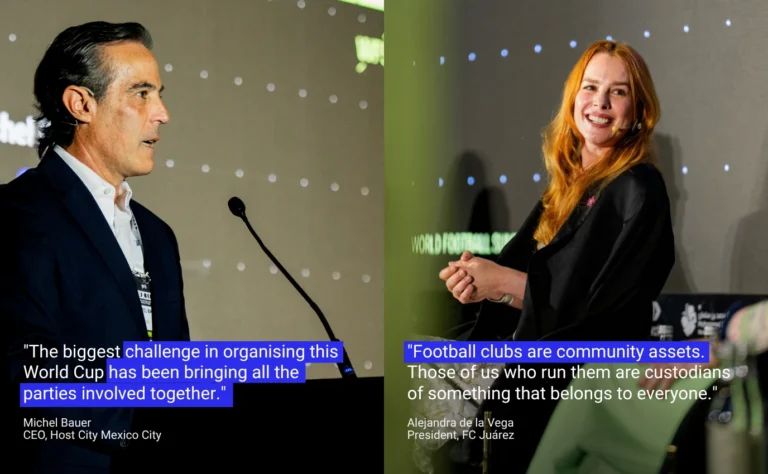
MEXICO CITY — Just days before the FIFA World Cup commenced at the iconic Estadio Azteca, more than 1,700 football industry leaders representing over 40 nations convened at the Camino Real Polanco for the third edition of the World Football Summit (WFS) Mexico City.
Over the course of two days, 137 speakers participated in more than 40 panel discussions, examining the opportunities, challenges, and innovations that are redefining football across the Americas and the global sporting landscape. Representatives from clubs, football federations, investment firms, media organizations, and technology companies shared perspectives on where the world’s most popular sport is headed.
The summit produced several notable takeaways that offer a glimpse into football’s future.
1. Mexican Football Is Rapidly Emerging as a Global Commercial Power
The 2026 FIFA World Cup may be drawing international attention to Mexico, but industry experts believe the country’s football sector was already on an impressive growth trajectory.
The Clausura 2026 final attracted more than 84 million viewers across Mexico and the United States, while the Liga MX Femenil final surpassed the UEFA Women’s Champions League final in television audience figures. With an estimated value of 52 billion pesos, Mexico’s football industry is now worth approximately five times more than the nation’s cinema sector.
Marc Spiegel, owner of Querétaro FC and one of Liga MX’s pioneering foreign investors, noted that the league has only begun to unlock its commercial potential.
“From a content perspective, we’re at about 10 percent. We’re in the second inning of a nine-inning game,” Spiegel stated.
Industry executive Kike Levy predicted that Liga MX could rank among the world’s six strongest football leagues within the next four years.
2. Football Matches Are No Longer the Entire Product
While the match remains the emotional centerpiece of football, industry leaders agree that modern fan engagement extends far beyond the ninety minutes played on the pitch.
Kelly Shouldice, Vice President of Brand and Content at the Northern Super League, emphasized that younger audiences increasingly seek storytelling and behind-the-scenes experiences rather than full-match broadcasts.
“The full match is the foundation, but it’s not the main product anymore,” she explained.
Sascha Fussmann of One Life Agency echoed this sentiment, highlighting the growing importance of player-centered narratives and personalized content. According to him, fans are increasingly interested in following individual athletes and their stories, creating new opportunities for clubs and leagues to deepen audience engagement.
3. Women’s Football Is Creating New Opportunities for Brands
Women’s football continues to emerge as one of the sport’s fastest-growing sectors, offering brands unique opportunities that are becoming increasingly difficult to find in the men’s game.
Claudia Carrión of Club América stressed the need to transform women’s football from a temporary trend into a sustained movement. Unlike the heavily commercialized men’s game, women’s football still provides room for innovation, audience development, and meaningful partnerships.
Stefano Petruzzo, Chief Executive Officer of Olympique de Marseille’s women’s team, explained that the lower commercial barriers allow clubs to experiment with fan experiences and long-term growth strategies rather than prioritizing only high-paying sponsorship deals.
4. Young Fans Want Participation, Not Just Entertainment
The next generation of football supporters has grown up in a digital ecosystem built around interaction, content creation, and instant engagement.
Alejandro Lesende of Concacaf revealed that the federation’s youth-focused initiative, Concacaf Kickoff, was developed alongside teenagers rather than for them. The approach reflects a broader shift across the industry toward co-creation and community building.
Industry experts noted that millions of sports-related posts are created daily on social media platforms, demonstrating that modern audiences expect to participate in the entertainment experience rather than simply consume it.
Clubs and federations achieving success with younger audiences are increasingly designing products and campaigns with direct input from the communities they aim to serve.
5. Data Has Value Only When It Drives Action
Football organizations are collecting unprecedented amounts of fan data, but summit participants warned that data alone does not guarantee success.
Joshua Flores of Tradable Bits argued that large follower counts are meaningless if supporters are not actively engaging with clubs or making transactions.
Club América’s extensive investment in fan intelligence systems has allowed the club to provide sponsors with deeper insights into supporter behavior, interests, and consumption habits.
A notable example came from Brazilian club Grêmio, which re-engaged inactive supporters simply by inviting them back to the stadium. The campaign resulted in 35 percent of recipients attending the next match, without the use of discounts or promotions.
6. Stadiums Must Generate Revenue Beyond Matchdays
Industry leaders agreed that modern stadiums can no longer afford to remain active only during football matches.
José Ramón Fernández of Grupo Pachuca stressed that venues must continue generating value long after the final whistle. Architects, developers, and club executives increasingly envision stadiums as mixed-use destinations featuring retail outlets, hospitality services, residential developments, and content production facilities.
Chris DeVolder of Gensler highlighted the challenge, noting that a stadium may only be utilized for a few hours each week despite existing year-round.
As Alejandro Barca of L35 Architects observed, “There is nothing more unsustainable than a building that isn’t used.”
7. Artificial Intelligence Is Becoming a Competitive Necessity
Artificial intelligence has moved beyond experimentation and is now playing a significant role in football operations.
LaLiga reported a 60 percent reduction in piracy through AI-driven monitoring systems, contributing to a substantial increase in broadcast rights revenue.
Daniel Benchimol of DAZN urged football organizations to embrace AI technologies immediately, warning that those who delay risk losing competitive ground.
LaLiga President Javier Tebas reinforced the message, arguing that organizations that fail to integrate artificial intelligence will struggle to remain efficient and competitive in the future.
8. Officiating Technology Is Creating Both Trust and Revenue
Mexico has become the first nation in the Americas to implement Semi-Automated Offside Technology, producing faster and more accurate decision-making.
During the Clausura 2026 season, offside decisions were delivered 25 percent faster, while average VAR review times were reduced from over one minute to just 39 seconds.
Beyond improving officiating, the technology has also created new commercial opportunities. Broadcast graphics associated with VAR reviews are now attracting sponsorship investments, transforming transparency tools into valuable media assets.
Industry experts believe that increased trust, clarity, and fan understanding are enhancing the overall viewing experience.
9. Gender Equality Remains One of Football’s Biggest Challenges
Despite significant progress in women’s football, speakers emphasized that major barriers remain worldwide.
Eglantina Zingg, founder of Goleadoras, highlighted that women are still excluded from football participation in many countries. Mary Connor of Common Goal stressed the urgency of accelerating progress, noting that women’s football has the power to influence careers, livelihoods, and national economic development.
With Brazil preparing to host the FIFA Women’s World Cup in 2027, stakeholders believe the tournament presents a crucial opportunity to advance inclusion and equality throughout the sport.
10. Purpose-Led Partnerships Are Delivering Stronger Results
A growing number of football organizations are shifting away from traditional sponsorship models and embracing purpose-driven partnerships that combine commercial objectives with social impact.
Mary Connor explained that brands are increasingly centering agreements around community development and philanthropy while integrating marketing assets into broader social initiatives.
Melissa Pardi of the U.S. Soccer Federation highlighted a partnership with Bank of America that brings football into schools through educational resources, equipment provision, and long-term development programs.
According to summit participants, these initiatives are helping brands establish deeper connections with communities while generating measurable returns that extend beyond conventional sponsorship visibility.
Conclusion
The discussions at World Football Summit Mexico City underscored a clear message: football is evolving far beyond the boundaries of the pitch. From artificial intelligence and data-driven engagement to women’s football, youth participation, and purpose-led partnerships, the sport’s future will be shaped by organizations willing to innovate, adapt, and connect with supporters in new ways.
As the global game enters a new era, those who embrace change may be best positioned to lead football’s next chapter.

 INN-HOUSE☆